
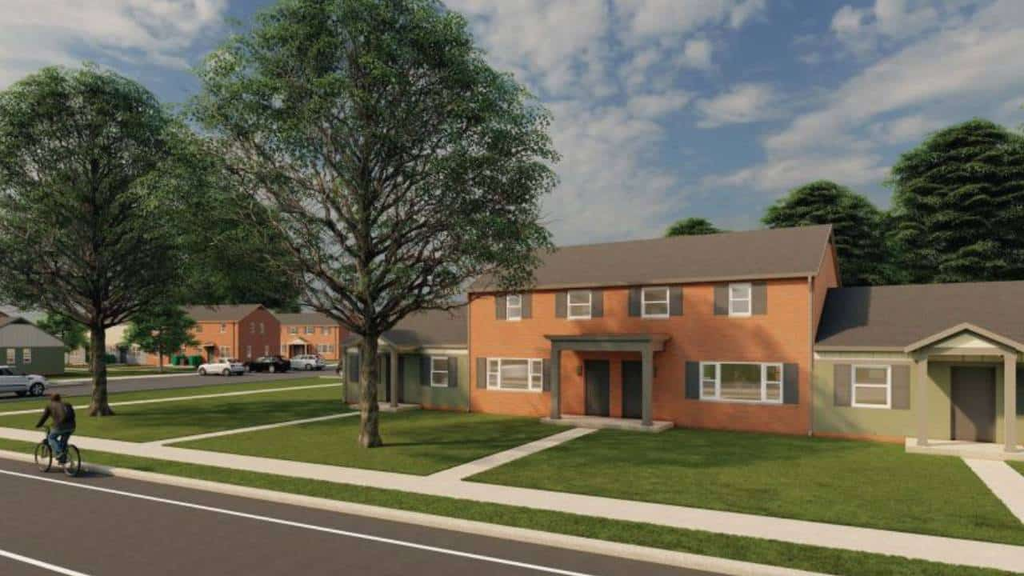
In one of the largest Low Income Housing Tax Credit (LIHTC) investments in Ohio history, a $144 million rehabilitation project will breathe new life into three 1950s-era public housing communities in the former shipbuilding powerhouse of Lorain, now a western suburb of Cleveland.
“We are a Rust Belt city. There is a great need for affordable housing,” explains Judith Carlin, chief executive officer of Raise Up (formerly Lorain Metropolitan Housing Authority), which owns and operates the public housing. “It’s in our interest for the community to be served by affordable housing that is renovated and can be sustained.”
The project will consolidate the three communities under one name, Western Horizon, with the combined 353 units slated to be fully renovated by June of 2028. Western Horizon will deliver units on a rolling basis to minimize disruption; the first phase is expected to be completed by the end of November.
Investor Freddie Mac — brought into the project by National Equity Fund — made the record-breaking $55 million LIHTC equity investment.
“Having a single investor do that makes the project unique as well,” says Dan Scheinman, chief financial and investment officer for Columbus-based TFG Housing Resources (TFGHR), the project’s developer.
Project History
Carlin says she and Gail Sayers Proby, chief operating officer at Raise Up, were exploring options to reposition the organization’s public housing portfolio. As part of that process, they attended the Ohio Housing Authorities Conference, where they met with TFGHR and Lument (a New York-based firm that, as part of a wider offering of transaction management services, helps advise local housing authorities on capital structures and financing). The two organizations were hosting open office hours for housing authorities interested in learning more about the Rental Assistance Demonstration (RAD) program and exploring potential repositioning strategies for their portfolios.
During the meeting, the team identified several potential conversion opportunities, including a strategy to combine the three Lorain projects, which had historically operated as separate entities, into a single, larger development.

Brad Carman, TFGHR’s president, says the initial meeting ultimately led to TFGHR being engaged as co-developer of the Western Horizon project. The team also identified a fourth property, Wilkes Villa in Elyria, Ohio, as a candidate for RAD conversion. That project, which is separate from the Western Horizon development, closed approximately six months ago.
The Department of Housing and Urban Development (HUD)’s RAD program allows public housing entities to convert traditional public housing projects into long-term project-based Housing Choice Voucher (HCV)-served properties, unlocking sorely needed capital for renovations via LIHTC equity and other forms of private debt.
For Western Horizon, this meant the ability to build a fairly standard — albeit sizable — capital stack typical of many LIHTC-funded transactions.
Permanent financing for the project includes: $28 million first mortgage originated by Lument under a government-backed Federal Housing Administration (FHA) 221(d)(4) loan; $51.57 million in seller financing from Raise Up; $100 in general partner capital from TFGHR and Raise Up; $10 million in deferred developer fee from TFGHR/Raise Up and $55.1 million in Freddie Mac tax equity syndicated by National Equity Fund.
Construction financing included: $33.76 million equity bridge loan from Fifth Third Bank and $43 million in tax-exempt bonds issued by Raise Up.
“The successful financing reflects the strong collaboration among TFGHR, Raise Up, HUD, and our team at Lument,” Joseph Hague, Lument’s managing director, told Tax Credit Advisor in a written statement. “Together, we developed a capital structure that supports a transformative renovation while protecting long-term affordability for hundreds of families.”
The federal loan was particularly impactful in getting the deal across the line, according to Hague. “The FHA 221(d)(4) program was an ideal solution as it funded construction and permanent financing with a 40-year term at a favorable interest rate, positioning the community for future success,” Hague continued. “We’re proud to play our part in this successful collaboration that is facilitating the construction of new, high-quality affordable housing for the community of Lorain.”
A Thorough Makeover
Carman says the RAD conversion enabled the team to put over $150,000 into the renovation of each unit — a significant rehab for an Ohio affordable preservation project.
This construction budget allowed the team to conduct a thorough renovation. “Pretty much everything within the units is being touched,” explains Carman. “We’re adding porches, overhangs, new fixtures, new appliances with energy efficient standards, new furnaces, new air condition, and exterior improvement. It’s not just a ‘band-aid’ approach.”
Original Article.